Learn about basic maintenance that you can perform on the vehicle yourself, as well as information about how to best maintain the vehicle.
Some of the most important safety precautions are listed below however, we cannot warn you of every conceivable hazard that can arise in performing maintenance. Only you can decide whether or not you should perform a given task.
Improperly maintaining this vehicle or failing to correct a problem before driving can cause a crash in which you can be seriously hurt or killed.
Always follow the inspection and maintenance recommendations according to the schedules in this guide.
Failure to properly follow maintenance instructions and precautions can cause you to be seriously hurt or killed.
Always follow the procedures and precautions in this guide.
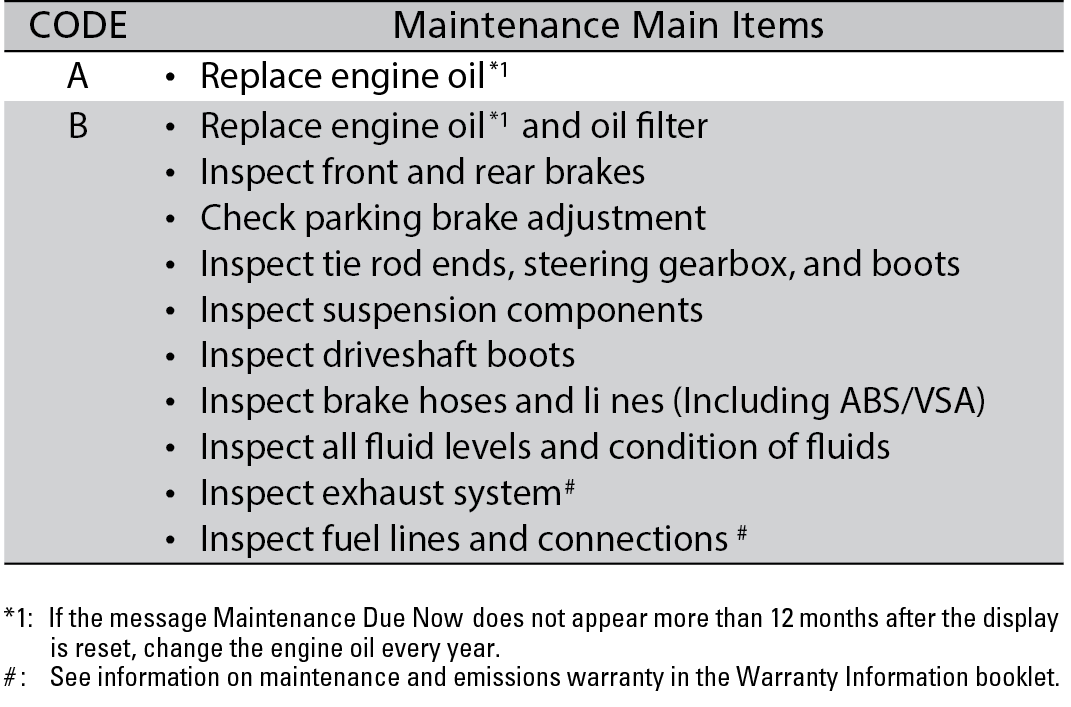
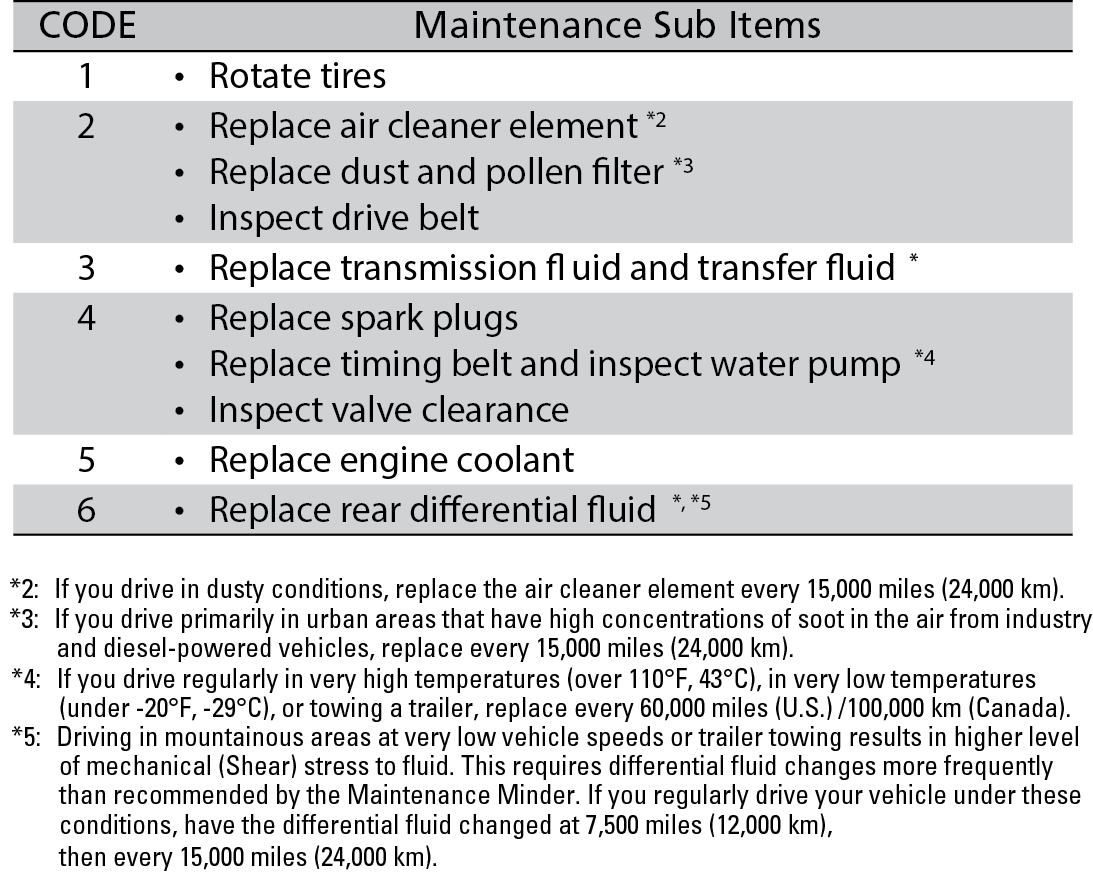
When maintenance is due, the system message indicator comes on and a message appears on the display every time you turn the vehicle on.
U.S. models
Maintenance, replacement, or repair of emissions control devices and systems may be done by any automotive repair establishment or individuals using parts that are certified to EPA standards.
According to state and federal regulations, failure to perform maintenance on the maintenance main items marked with # will not void your emissions warranties. However, all maintenance services should be performed in accordance with the intervals indicated by the multi-information display.
These codes indicate what services are due on your vehicle.
When closing the hood, lower it to approximately 12 inches (30 cm) and press firmly down with your hands.
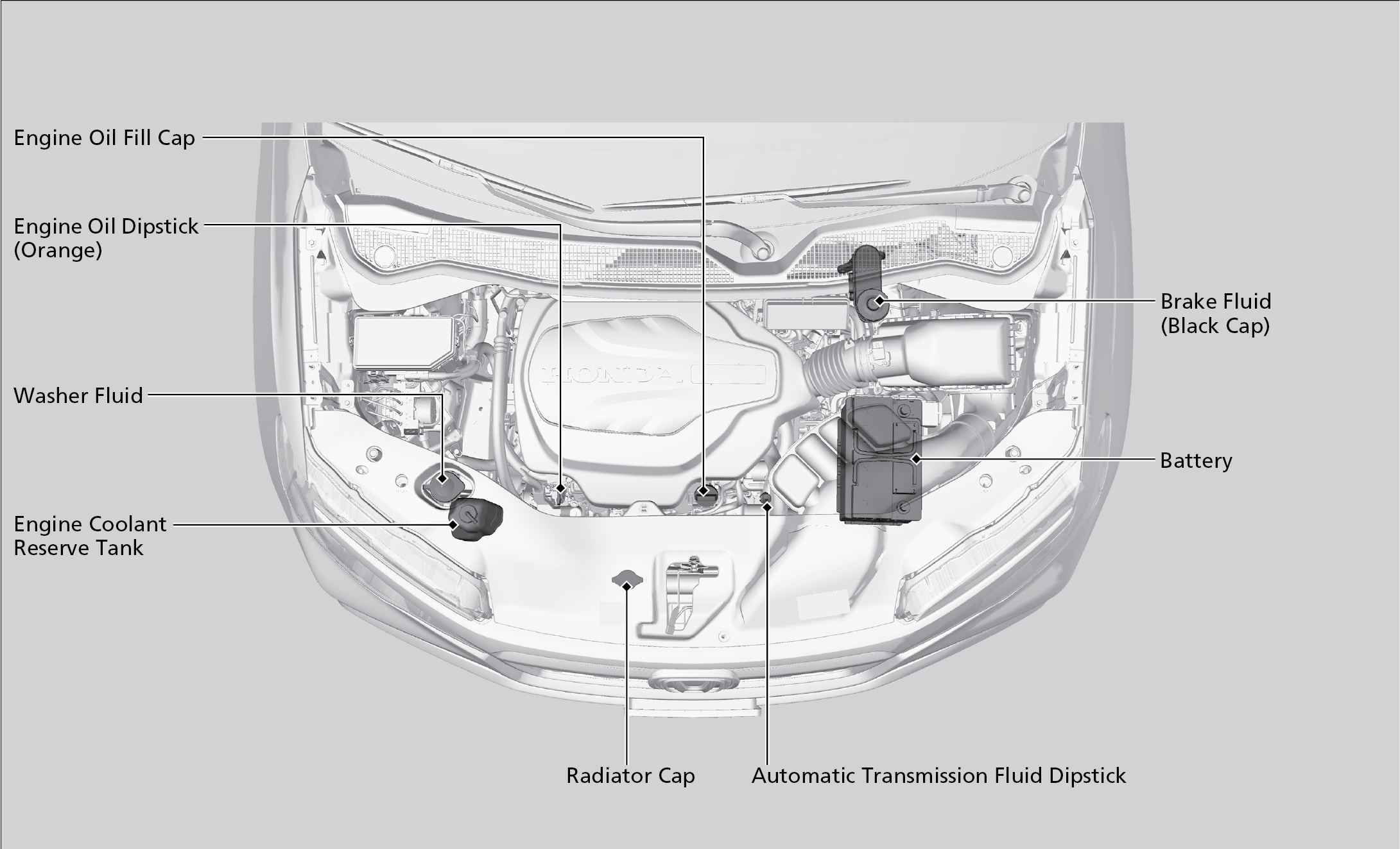
The component parts in the engine compartment are protected by a cover. You may need to remove the cover when you perform certain maintenance work.
Starting at either side, lift the outermost edge of the engine compartment cover. Pull up on the cover, and remove it from the pins. Move towards the opposite side while applying uniform upward pressure.
Park the vehicle on level ground. Wait approximately three minutes after turning the engine off before you check the oil.
Add oil if necessary.
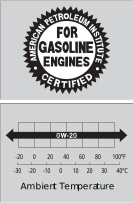
This seal indicates the oil is energy conserving and that it meets the American Petroleum Institute’s latest requirements.
Use Genuine Honda Motor Oil or another commercial engine oil of suitable viscosity for the ambient temperature.
You may also use synthetic motor oil if it is labeled with the API Certification Seal and is of the specified viscosity grade.
Park the vehicle on level ground. Check the reserve tank and the coolant level in the radiator. Use Honda Long Life Antifreeze/Coolant Type 2.
Always let the engine and radiator cool down before removing the radiator cap.
The battery condition is monitored by the sensor on the negative terminal. If there is a problem with the sensor, a message appears on the multi-information display. Have your vehicle checked by a dealer.
A spark or flame can cause the battery to explode with enough force to kill or seriously hurt you.
When conducting any battery maintenance, wear protective clothing and a face shield, or have a skilled technician do it.
Check the amount of window washer fluid by looking at the reservoir. Fill if it is low. Pour the washer fluid carefully. Do not overflow the reservoir.
Models with washer level sensor
If the washer fluid is low, a message appears on the multi-information display.
The fluid level should be between the MIN and MAX marks on the side of the tank. We recommend using Honda Heavy Duty Brake Fluid DOT 3.
Pour the fluid carefully.
If the fluid level is at or below the MIN mark, have a dealer inspect for leaks or worn brake pads as soon as possible.
To safely operate your vehicle, your tires must be of the proper type and size, in good condition with adequate tread, and properly inflated.
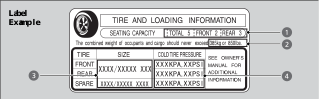
The label attached to the driver’s doorjamb provides necessary tire and loading information.
Replace your tires with radials of the same size, load range, speed rating, and maximum cold tire pressure rating (as shown on the tire’s sidewall). Using tires of a different size or construction can cause certain vehicle systems to work incorrectly. It is best to replace all four tires at the same time. If that isn’t possible, replace the front or rear tires in pairs.
This can cause a crash in which you can be seriously hurt or killed.
Always use the size and type of tires recommended in the Owner’s Manual.
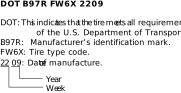
The life of your tires is dependent on many factors, including driving habits, road conditions, vehicle loading, inflation pressure, maintenance history, speed, and environmental conditions (even when the tires are not in use).
In addition to regular inspections and inflation pressure maintenance, it is recommended that you have annual inspections performed once the tires reach five years old. All tires, including the spare, should be removed from service after 10 years from the date of manufacture, regardless of their condition or state of wear.
If driving on snowy or frozen roads, mount all season tires marked “M+S”, snow tires, or tire chains; reduce speed and maintain sufficient distance between vehicles when driving. For winter tires, select the size and load ranges that are the same as the original tires, and mount them to all four wheels.
Install tire chains on the front tires only. Because your vehicle has limited tire clearance, we strongly recommend using the following chains:
Cable type: SSC Super Z LT-ZT735
Mount chains as tightly as you can and make sure that they do not touch the brake lines or suspension.
Follow all instructions in this guide regarding the selection and use of tire chains.
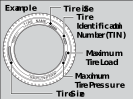
The tires that came on your vehicle have a number of markings. Those you should be aware of are described below.
Here is an example of what each marking means:
Cold Tire Pressure – The tire air pressure when the vehicle has been parked for at least three hours or driven less than 1 mile (1.6 km).
Load Rating – The maximum load that a tire is rated to carry for a given inflation pressure.
Maximum Inflation Pressure – The maximum tire air pressure that the tire can hold.
Maximum Load Rating – The load rating for a tire at the maximum permissible inflation pressure for that tire.
Recommended Inflation Pressure – The cold tire inflation pressure recommended by the manufacturer.
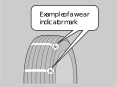
Treadwear Indicators (TWI) – The projections within the principal grooves designed to give a visual indication of the degrees of wear of the tread.
The tires on your vehicle meet all U.S. Federal Safety Requirements. All tires are also graded for treadwear, traction, and temperature performance according to Department of Transportation (DOT) standards. These gradings are explained below.
Quality grades can be found where applicable on the tire sidewall between tread shoulder and maximum section width.
For example:
Treadwear 200
Traction AA
Temperature A
All passenger car tires must conform to Federal Safety Requirements in addition to these grades.
The treadwear grade is a comparative rating based on the wear rate of the tire when tested under controlled conditions on a specified government test course. For example, a tire graded 150 would wear one and one-half (1 1/2) times as well on the government course as a tire graded 100. The relative performance of tires depends upon the actual conditions of their use, however, and may depart significantly from the norm due to variations in driving habits, service practices, and differences in road characteristics and climate.
The traction grades, from highest to lowest, are AA, A, B, and C. Those grades represent the tire’s ability to stop on wet pavement as measured under controlled conditions on specified government test surfaces of asphalt and concrete. A tire marked C may have poor traction performance.
WARNING: The traction grade assigned to this tire is based on straight-ahead braking traction tests, and does not include acceleration, cornering, hydroplaning, or peak traction characteristics.
The temperature grades are A (the highest), B, and C, representing the tire’s resistance to the generation of heat and its ability to dissipate heat when tested under controlled conditions on a specified indoor laboratory test wheel. Sustained high temperature can cause the material of the tire to degenerate and reduce tire life, and excessive temperature can lead to sudden tire failure. The grade C corresponds to a level of performance which all passenger car tires must meet under the Federal Motor Vehicle Safety Standard No. 109. Grades B and A represent higher levels of performance on the laboratory test wheel than the minimum required by law.
WARNING: The temperature grade for this tire is established for a tire that is properly inflated and not overloaded. Excessive speed, underinflation, or excessive loading, either separately or in combination, can cause heat buildup and possible tire failure.
To ensure proper and safe operation, the Society of Automotive Engineers (SAEJ2845) recommends that the refrigerant system only be serviced by trained and certified technicians.
Never repair or replace the air conditioning evaporator (cooling coil) with one removed from a used or salvaged vehicle.
New replacement mobile air conditioning evaporators must be certified (and labeled) as meeting SAE Standard J2842.
Your vehicle has readiness codes as part of the onboard self-diagnostic system. Some states use these codes for testing to verify whether your vehicle’s emissions components are working properly. The codes may not be read if you go through the testing just after the battery has gone dead or been disconnected.
To check if they are set, set the power mode to ON without starting the engine. The malfunction indicator lamp will come on for several seconds. If it goes off, the readiness codes are set. If it blinks five times, the readiness codes are not set.
The readiness codes are erased when the battery is disconnected. The codes are set again only after several days of driving under a variety of conditions.
If a testing facility determines that the readiness codes are not set, you may be requested to return at a later date to complete the test or see your dealer.