
Driving Preparation
Exterior Checks
- Make sure there are no people or objects behind or around the vehicle.
- There are blind spots from the inside.
- Make sure the tires are in good condition.
- Check air pressures, and check for damage and excessive wear.
- Make sure the hood is securely closed.
- If the hood opens while driving, your front view will be blocked.
- Make sure there are no obstructions on the windows, door mirrors, exterior lights, or other parts of the vehicle.
- Remove any frost, snow, or ice.
- Remove any snow on the roof, as this can slip down and obstruct your field of vision while driving or fall off and impact other road users. If frozen solid, remove ice once it has softened.
- When removing ice from around the wheels, be sure not to damage the wheel or wheel components.
- Make sure the door is not frozen.
- When doors are frozen shut, use warm water around the door edges to melt any ice. Do not try to force them open, as this can damage the rubber trim around the doors. When done, wipe dry to avoid further freezing.
- Make sure that there are no flammable materials left under the hood.
- Be especially careful if the vehicle has not been used for a long time, or after maintenance. The heat from the engine and exhaust may cause flammable materials to catch fire, leading to unexpected accidents.
- Never carry more than 165 lbs (75 kg) of cargo on the roof rack (Honda accessory).
Interior Checks
- After everyone has entered the vehicle, be sure all doors and the tailgate are closed and locked. Locking the doors and the tailgate helps prevent an occupant from being ejected and an outsider from unexpectedly opening a door or the tailgate.
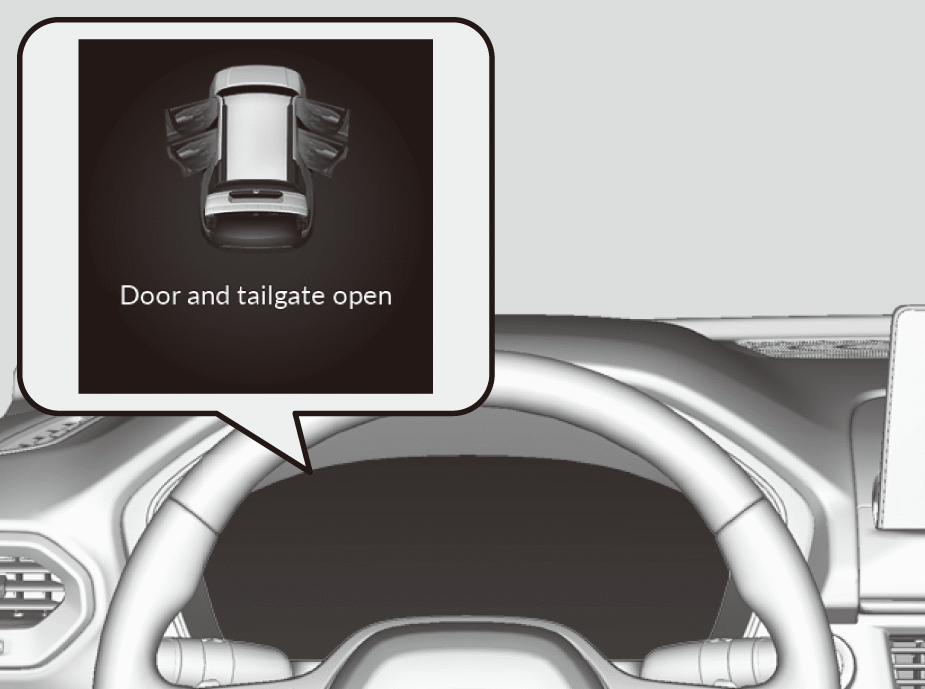
- If the door and/or tailgate open message appears on the driver information interface, a door and/or the tailgate is not completely closed. Close all doors and the tailgate tightly until the message disappears.
- Adjust your seat to a position suitable for driving. Be sure the front seats are adjusted as far to the rear as possible while allowing the driver to control the vehicle. Sitting too close to a front airbag can result in serious or fatal injury in a crash.
- Adjust head restraints to the proper position. Head restraints are most effective when the center of the head restraint aligns with the center of your head. Taller persons should adjust their head restraint to the highest position.
- Always wear your seat belt, and make sure you wear it properly. Confirm that any passengers are properly belted as well.
- Protect children by using seat belts or child seats according to a child’s age, height, and weight.
- Do not place anything in the front seat footwells. Make sure to secure the floor mat.
- An object or unsecured floor mat can interfere with your brake and accelerator pedal operation while driving.
- Store or secure all items on board properly.
- Carrying too much cargo, or improperly storing it, can affect your vehicle’s handling, stability, stopping distance, and tires, and make it unsafe.
- Do not pile items higher than the seatback height.
- They can block your view and may be thrown forward in the event of sudden braking.
- Adjust the mirrors and steering wheel properly.
- Adjust them while sitting in the proper driving position.
- Be sure items placed on the floor behind the front seats cannot roll under the seats.
- They can interfere with the driver’s ability to operate the pedals, the operation of the seats, or the operation of the sensors under the seats.
- If you have any animals on board, do not let them move around in the vehicle.
- They may interfere with driving and a crash could occur.
- Make sure that the indicators in the instrument panel come on when you start the vehicle, and go off soon after.
- Always have a dealer check the vehicle if a problem is indicated.
The headlight aim is set by the factory, and does not need to be adjusted. However, if you regularly carry heavy items in the cargo area or tow a trailer, have the aiming readjusted at a dealer or by a qualified technician.