
CMBS™ Limitations
In the following situations, the radar sensor or camera may be unable to correctly identify detectable targets or road conditions, potentially causing the CMBS™ to operate improperly.
Environmental conditions
- Driving in bad weather (rain, fog, snow, etc.).
- Sudden changes between light and dark, such as an entrance or exit of a tunnel.
- There is little contrast between detectable targets and the background.
- Driving into low sunlight (e.g., at dawn or dusk).
- Strong light is reflected onto a detectable target or roadway.
- Driving in the shadows of trees, buildings, etc.
- Reflections on the interior of the windshield.
- Driving at night or in a dark place such as a tunnel (due to low-light conditions, detectable target may not be illuminated).
- When nearby radio wave emitting devices such as other automotive radar sensors.
Roadway conditions
- Driving on a snowy or wet roadway (obscured lane marking, vehicle tracks, reflected lights, road spray, high contrast).
- Driving on curvy, winding, or undulating roads.
- The road is hilly or the vehicle is approaching the crest of a hill.
- Your vehicle is strongly shaken on uneven road surfaces.
- Driving through an area where there are objects that strongly reflect radio waves onto vehicles, pedestrians, or moving bicycles.
Vehicle conditions
- Driving at night or in a dark place (e.g., a tunnel) with the headlights off.
- The front of the camera is obstructed by dirt, fog, rain, mud, wet snow, accessories, decals, stickers, film, etc.
- The area around the front grille is obstructed by dirt, rain, mud, wet snow, accessories, decals, stickers, film, etc.
- There is residue on the windshield from the windshield wipers.
- The inside of the windshield is fogged.
- When lighting is weak due to dirt covering the headlight lenses, or there is poor visibility in a dark place due to the headlights being improperly adjusted.
- An abnormal tire or wheel condition (incorrect sizes, varied sizes or construction, improperly inflated, compact spare tire, etc.).
- The vehicle is tilted due to heavy load in the cargo area or rear seats.
- The suspension has been modified.
- Driving with the parking brake applied.
- Tire chains are installed.*
- The vehicle is towing a trailer.
Examples of limitations on the correct detection of the radar and camera due to the condition of detectable targets
- The distance between your vehicle and the detectable target is too short.
- The detectable target suddenly cuts in front of or jumps out in front of you.
- The bicycle is stopped.
- The oncoming vehicle or vehicle ahead of you is sideways or facing diagonally.
- When the detectable target blends in with the background, preventing the system from recognizing it.
- When several pedestrians are moving ahead of you in a group.
- When several bicycles are moving ahead of you in a group.
- When a pedestrian or moving bicycle crosses the road too quickly.
- A pedestrian or moving bicycle approaches from the opposite direction.
- The headlights of the vehicle ahead of you or oncoming vehicle are lit on one side or not lit on either side in a dark place.
- When part of a pedestrian (heads, limbs, etc.) is hidden by a carried object.
- When a pedestrian is bent over or squatting, when their hands are raised, or when they are running.
- When the pedestrian is shorter than about 3.3 feet (1 meter) or taller than about 6.6 feet (2 meters) in height.
- When the pedestrian is pushing a stroller or bicycle.
Examples of other limitations on detection or system operation
- When the vehicle ahead of you is a small motorcycle, motorcycle with a sidecar, wheelchair, or other specially shaped vehicle.
- When a vehicle is lower in the rear than the front such as trucks that are not carrying a cargo, or a narrow vehicle.
- When the detectable target is not in front of the vehicle.
- The speed difference between your vehicle and the detectable target is significantly large.
- The speed difference between your vehicle and the detectable target is too small and the distance between your vehicle and them is too short.
- When a vehicle (including motorcycles) or moving bicycle in front of you slows suddenly.
- When the driver operates the brake pedal and steering wheel to avoid a collision.
- When you approach the detectable target while accelerating rapidly or operating the steering wheel (except when turning left at an intersection, etc.)*1
- When the moving bicycle is a child-sized bicycle, folding bicycle, three-wheeler or other bicycle with small tires, or a long bicycle like a tandem bicycle.
- When the front of the camera cannot correctly identify the shape of the detectable target.
- When the minimum ground clearance of a vehicle that is ahead of you is extremely high.
*1: When there is a possibility of a frontal collision with the oncoming vehicle while turning left, the CMBS™ is activated. However, it may not be activated if you suddenly turn the steering wheel.
With little chance of a collision
Even if there is little chance of a collision, the CMBS™ may activate in the following situations, such as when the system determines that there is a possibility of collision with a detectable target.
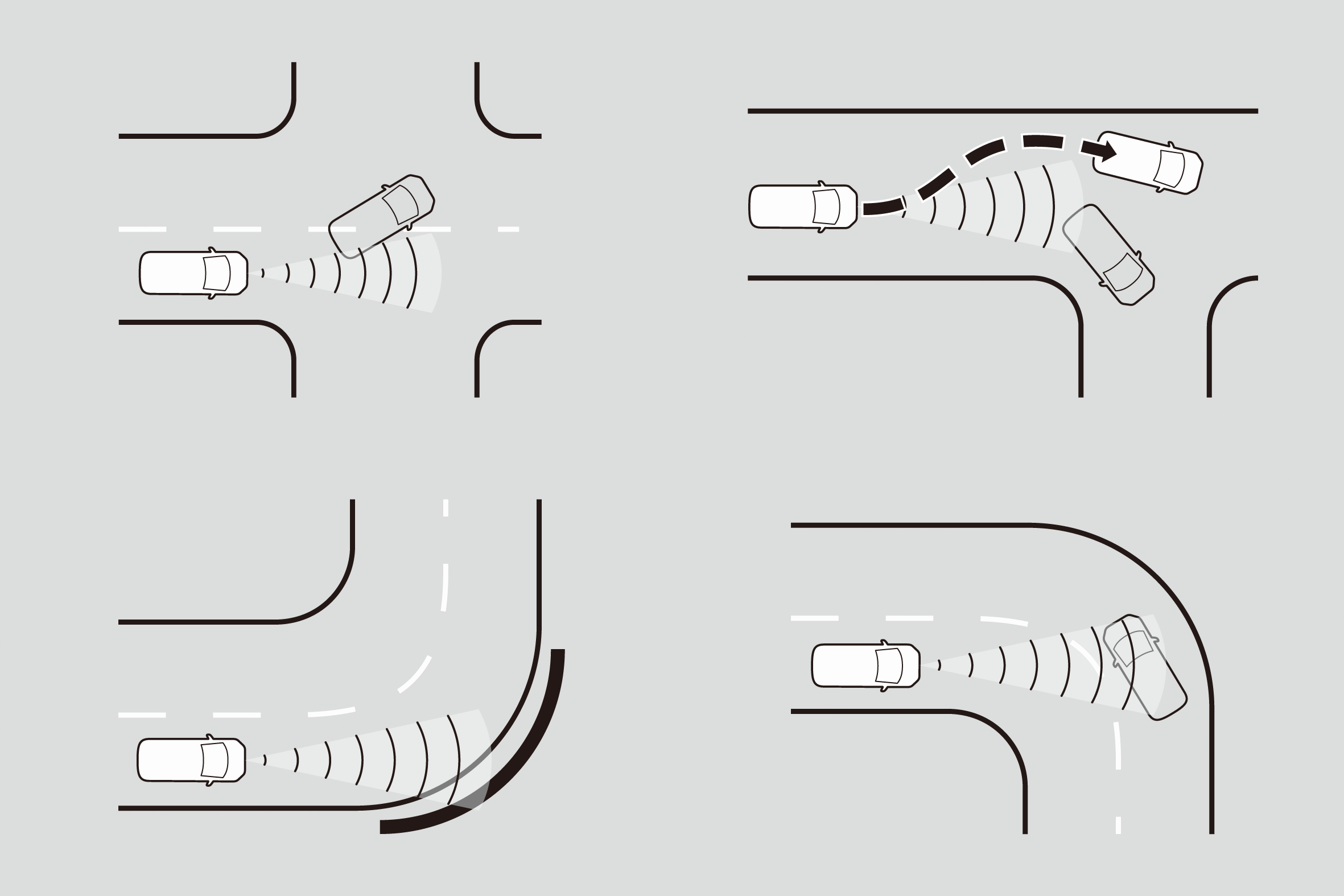
- When your vehicle approaches a vehicle ahead that is turning left or right.
- Your vehicle approaches another vehicle ahead of you and you change lanes to pass.
- When there are detectable targets or any structures around the curved road.
- When driving through curves, your vehicle comes to a point where the oncoming vehicle is left in front of you.
- When your vehicle approaches a detectable target.
- When detectable targets are passing in front of you.
- When you drive under a low structure or through a narrow gate at high speed.
- When approaching stationary vehicles or walls, such as when parking.
- Roadway objects or structures such as guard rails, poles, trees, parked vehicles, buildings, walls, etc., or road markings and road lines are misinterpreted as detectable targets.
*: Not available on all models