


USB Ports
-
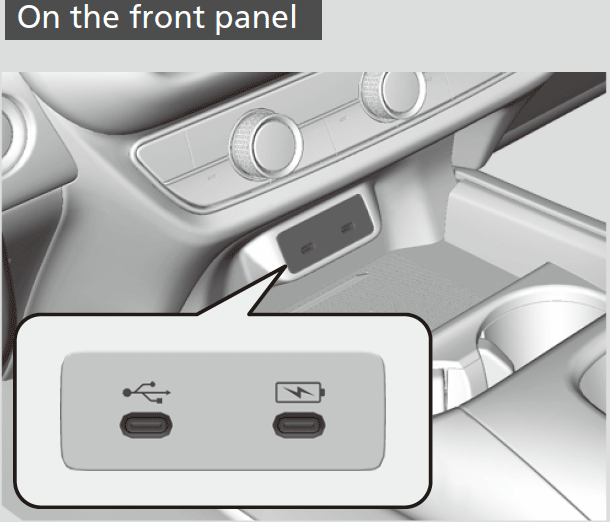
USB charging/connector port (
 )
)The USB port is for charging devices, playing audio files, and connecting compatible phones with Apple CarPlay or Android Auto.
- To prevent any potential issues, be sure to use an Apple MFi Certified Lightning Connector for Apple CarPlay. The USB cables should be certified by USB-IF to be compliant with USB 2.0 Standard.
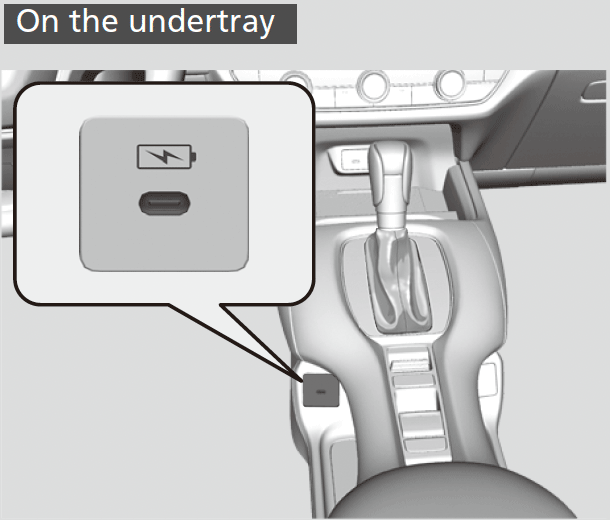
USB charging port on the front panel (
 )
)The USB port is only for charging devices.
- You cannot play music even if you have connected music players to it.
-
- Detail
-
- Do not leave the iPod or USB flash drive in the vehicle. Direct sunlight and high temperatures may damage it.
- We recommend that you use a USB cable if you are attaching a USB flash drive to the USB port.
- Do not connect the iPod or USB flash drive using a hub.
- Do not use a device such as a card reader or hard disk drive, as the device or your files may be damaged.
- We recommend backing up your data before using the device in your vehicle.
- Displayed messages may vary depending on the device model and software version.
- Some devices may not work even if they are connected to the USB ports.
Supplementary information about USB Charging:
- The USB ports on the front panel support USB Power Delivery.
- USB standard output
When using 1 port: 5V/3A(15W), 9V/3A(27W), 15V/3A(45W), 20V/3A(60W)
When using both ports: 5V/3A(15W), 9V/3A(27W), 20V/2.25A(45W), Max 60W in total
For amperage details, read the operating manual of the device that needs to be charged. - The USB port also supports PPS (Programmable Power Supply).
PPS 5.0V-21V (Max 60W). - Charging may not start or may operate slowly depending on the connected devices and cables. Using only one port while not connecting anything (including cables) to the other port may solve the issue.
- Recommended topic(s)