


Temporarily Repairing a Flat Tire
If the tire has a large cut or is otherwise severely damaged, you will need to have the vehicle towed. If the tire only has a small puncture, from a nail for instance, you can use the temporary tire repair kit so that you can drive to the nearest service station for a more permanent repair.
If a tire goes flat while driving, grasp the steering wheel firmly and brake gradually to reduce speed. Then, stop in a safe place.
- Park the vehicle on a firm, level, non-slippery surface and apply the parking brake.
- Put the transmission into P.
- Turn on the hazard warning lights and set the power mode to VEHICLE OFF.
- Detail
-
The kit should not be used in the following situations. Instead, contact a dealer or roadside assistance to have the vehicle towed.
- The tire sealant has expired.
- More than one tire is punctured.
- The puncture or cut is larger than 5/32 inch (4 mm).
- The tire side wall is damaged or the puncture is outside the contact area.

- Damage has been caused by driving with the tire extremely under inflated.
- The tire bead is no longer seated.
- The rim is damaged.
Do not remove a nail or screw that punctured the tire. If you remove it from the tire, you may not be able to repair the puncture using the kit.
Getting Ready to Temporarily Repair the Flat Tire

-
- Pull the strap on the floor lid and open the lid.
-

-
- Take the kit out of the case.
- Place the kit face up on flat ground near the flat tire and away from traffic. Do not place the kit on its side.
-

- Detail
-
When making a temporary repair, carefully read the instruction label applied on the kit.
Injecting Sealant and Air
-
- Remove the valve cap from the tire valve stem.
-

-
- Shake the sealant bottle.
- Attach the sealant/air hose onto the tire valve stem. Screw it until it is tight.
- Make sure the bottle remains upright to ensure all the sealant flows into the tire.
-

-
- Remove the bottle cap from the bottle adapter.
- Attach the air compressor hose onto the bottle adapter. Screw it until it is tight.
-

-
- Plug in the compressor to the accessory power socket.
- Be careful not to pinch the cord in a door or window.
- Turn on the vehicle's power system.
- Keep the power system on while injecting sealant and air.
- Plug in the compressor to the accessory power socket.
-

-
- Press the air compressor switch to turn on the kit.
- The compressor starts injecting sealant and air into the tire.
- After the air pressure reaches the specified pressure, turn off the kit.
- Check the air pressure gauge on the air compressor.
- Refer to the driver's doorjamb label for the specified pressure.
- Unplug the kit from the accessory power socket.
- Unscrew the sealant/air hose from the tire valve stem. Reinstall the valve cap.
- Press the air compressor switch to turn on the kit.
-

-
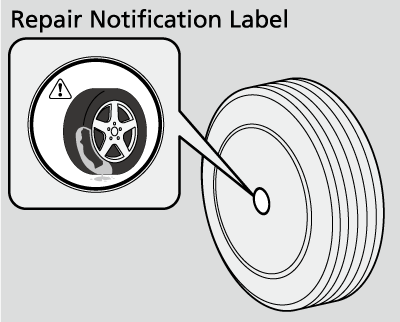
- Apply the repair notification label to the flat surface of the wheel.
- The wheel surface must be clean to ensure the label adheres properly.
- Apply the repair notification label to the flat surface of the wheel.
-
- WARNING
-
Tire sealant contains substances that are harmful and can be fatal if swallowed.
If accidentally swallowed, do not induce vomiting. Drink plenty of water and get medical attention immediately.
For skin or eye contact, flush with cool water and get medical attention if necessary.
- WARNING
-
Running the engine with the vehicle in an enclosed or even partly enclosed area can cause a rapid buildup of toxic carbon monoxide.
Breathing this colorless, odorless gas can cause unconsciousness and even death. Only run the engine to power the air compressor with the vehicle outdoors.
- Detail
-
Keep the sealant bottle out of the reach of children.The sealant is latex based and can permanently stain clothing and other materials. Be careful during handling and wipe up any spills immediately.
NOTICE
Do not operate the temporary tire repair kit compressor for more than 15 minutes. The compressor can overheat and become permanently damaged.
Until the sealant injection is complete, the pressure shown on the pressure gauge will appear higher than actual. After the sealant injection is complete, the pressure will drop and then begin to rise again as the tire is inflated with air. This is normal. To accurately measure the air pressure using the gauge, turn the air compressor off only after the sealant injection is complete.If the required air pressure is not reached within 10 minutes, the tire may be too severely damaged for the kit to provide the necessary seal, and your vehicle will need to be towed.See a dealer for a replacement sealant bottle and proper disposal of an empty bottle.
Distributing the Sealant in the Tire
-
- Apply the speed restriction label to the location as shown.
- Drive the vehicle for about 10 minutes.
- Do not exceed 50 mph (80 km/h).
- Stop the vehicle in a safe place.
-

-
- Recheck the air pressure using the air compressor hose on the compressor.
- Do not turn the air compressor on to check the pressure.
- Recheck the air pressure using the air compressor hose on the compressor.
-

- If the air pressure is
- Less than 19 psi (130 kPa):
- Front: 35 psi (240 kPa) /rear: 33 psi (230 kPa) or more:
- If the air pressure does not go down after the 10 minute driving, you do not need to check the pressure any more.
- Greater than 19 psi (130 kPa), but less than front: 35 psi (240 kPa)/rear: 33 psi (230 kPa):
Inflating an Under-inflated Tire
Then, drive carefully for 10 more minutes or until you reach the nearest service station, whichever is sooner. Do not exceed 50 mph (80 km/h). If you have not reached a service station, stop and check the tire pressure.- You should repeat this procedure as long as the air pressure is within this range.
- Unplug the kit from the accessory power socket.
- Unscrew the air compressor hose from the tire valve stem. Reinstall the valve cap.
- Repackage and properly stow the kit.
- WARNING
-
Running the engine with the vehicle in an enclosed or even partly enclosed area can cause a rapid buildup of toxic carbon monoxide.
Breathing this colorless, odorless gas can cause unconsciousness and even death. Only run the engine to power the air compressor with the vehicle outdoors.
Inflating an Under-inflated Tire
You can use the kit to inflate a non-punctured under-inflated tire.
-
- Open the cargo area floor lid.
- Remove the kit from the case.
- Place the kit face up on flat ground near the tire to be inflated, away from traffic. Do not place the kit on its side.
- Remove the valve cap.
-

-
- Attach the air compressor hose onto the tire valve stem. Screw it until it is tight.
-


-
- Plug in the compressor to the accessory power socket.
- Be careful not to pinch the cord in a door or window.
- Turn on the vehicle's power system.
- Keep the power system on while injecting air.
- Press the air compressor switch to turn on the kit.
- The compressor starts to inject air into the tire.
- Inflate the tire to the specified air pressure.
- Plug in the compressor to the accessory power socket.
-

-
- Turn off the compressor.
- Check the pressure gauge on the air compressor.
- If overinflated, deflate the tire using the pressure release tool.
- Unplug the kit from the accessory power socket.
- Unscrew the air compressor hose from the tire valve stem. Reinstall the valve cap.
- Turn off the compressor.
-

-
- Repackage and properly stow the kit.
-

- WARNING
-
Running the engine with the vehicle in an enclosed or even partly enclosed area can cause a rapid buildup of toxic carbon monoxide.
Breathing this colorless, odorless gas can cause unconsciousness and even death. Only run the engine to power the air compressor with the vehicle outdoors.
- Detail
-
NOTICE
Do not operate the temporary tire repair kit compressor for more than 15 minutes. The compressor can overheat and become permanently damaged.
- Recommended topic(s)