
When Indicators Come On/Blink
Indicators come on/blink depending on the condition of the vehicle. Messages may be displayed at the same time. Please take the appropriate action outlined in the message, such as having your vehicle checked by a dealer.
If a message is displayed saying the vehicle cannot be driven, immediately stop in a safe place and contact a dealer.
After reconnecting the 12-volt battery, if multiple indicators come on and Systems initializing is displayed: with the engine running, turn the steering wheel to the left until it stops then to the right until it stops, then drive a short distance at more than 12 mph (20 km/h). If the indicators do not go off, have your vehicle checked by a dealer.
U.S. Canada
 Parking Brake and Brake System Indicator (Red)
Comes on when the parking brake is applied, and goes off when it is released.
Comes on when the brake fluid level is low.
- Depress the brake pedal lightly to check pedal pressure.
- If normal, check the brake fluid level the next time you stop.
- If abnormal, take immediate action. If necessary, downshift the transmission to slow the vehicle using engine braking.
- Have your vehicle repaired immediately. It is dangerous to drive with low brake fluid. If there is no resistance from the brake pedal, stop immediately in a safe place. If necessary, downshift the gears.
Comes on if there is a problem with the brake system.
- If the Parking Brake and Brake System Indicator (Red) and Parking Brake and Brake System Indicator (Amber) come on simultaneously, the braking system may be less effective than usual. Make sure to depress the brake pedal firmly. Immediately stop in a safe place and contact a dealer.
- If the Parking Brake and Brake System Indicator (Red) and ABS indicator come on simultaneously, the electronic brake distribution system is not working. This can result in vehicle instability under sudden braking. Have your vehicle inspected by a dealer immediately.
Blinks if there is a problem with the electric parking brake.
- Do not use the parking brake.
- Put the transmission into P to prevent the vehicle from moving, as the parking brake may not work.
- If the Parking Brake and Brake System Indicator (Red) blinks at the same time when the Parking Brake and Brake System Indicator (Amber) comes on, the parking brake may not work. Avoid using the parking brake and have your vehicle checked by a dealer immediately.
U.S. Canada
 Parking Brake and Brake System Indicator (Amber)
Comes on if there is a problem with a system related to braking other than the conventional brake system.
Comes on if there is a problem with the electric parking brake system and/or the automatic brake hold system.
- Do not use the parking brake.
- Comes on if the vehicle is tilted due to heavy luggage in the cargo space or rear seats.
 12-Volt Battery Charging System Indicator
Comes on when there is a problem with the charging system.
 Seat Belt Reminder Indicator
Comes on or blinks when any seat belts are unfastened.
- Securely fasten seat belts immediately.
- Comes on or blinks when a seat belt in the rear seat is unfastened. Turns off momentarily.
- If this indicator stays on after you and/or the passengers have fastened the seat belt(s), a detection error may have occurred in the sensor. Have your vehicle checked by a dealer.
- You can check whether each seat belt is fastened on the driver information interface.
 Supplemental Restraint System Indicator
Comes on if a problem with the airbag system or seat belt tensioners is detected.
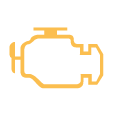 Malfunction Indicator Lamp
After you set the power mode to ON, this indicator will turn on for a short time while performing system checks. Immediately after, this indicator will blink several times if the readiness codes are not set.
- Readiness codes are part of the on-board diagnostics for the emissions control systems.
Comes on if there is a problem with the engine’s emissions control systems.
- If you drive with the malfunction indicator lamp on, the emissions control system and the engine could be damaged.
Blinks when a misfire in the engine’s cylinders is detected.
- Park the vehicle in a safe place with no flammable items and wait at least 10 minutes or more with the engine stopped until it cools.
 Low Fuel Indicator
Comes on when the fuel reserve is running low (approximately 2.77 U.S. gal/10.5 Liter left).
Blinks if there is a problem with the fuel gauge.
 Anti-lock Brake System (ABS) Indicator
Comes on if there is a problem with the ABS.
- With this indicator on, your vehicle still has normal braking ability but no ABS function. This can result in vehicle instability under sudden braking, so avoid situations such as highway driving.
 Vehicle Stability Assist™ (VSA®) System Indicator
Blinks when VSA®, or trailer stability assist is active.
Comes on if there is a problem with the VSA® system, brake assist system, hill start assist system, starting assist brake function, agile handling assist, or trailer stability assist.
- With this indicator on, your vehicle still has normal braking ability.
- When Trailer stability assist system problem is displayed on the driver information interface, the VSA® does not activate.
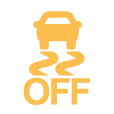 Vehicle Stability Assist™ (VSA®) OFF Indicator
Comes on when you partially disable VSA®.
Vehicle Stability Assist™ (VSA®), aka Electronic Stability Control (ESC), System
Comes on in TRAIL and SAND drive modes.
 Electric Power Steering (EPS) System Indicator
Comes on if there is a problem with the EPS system.
- Stop your vehicle in a safe place. If this indicator stays on after restarting the engine, take your vehicle to a dealer for an inspection immediately.
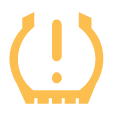 Low Tire Pressure/TPMS Indicator
Comes on if the tire pressure of any of the tires becomes low.
- Stop in a safe place, check tire pressures, and inflate the tire(s) if necessary.
If this indicator stays on after blinking, there is a problem with the TPMS with Tire Fill Assist.
- This indicator also comes on when a compact spare tire is installed.
 Transmission System Indicator
Blinks if the transmission system has a problem.
Blinks if you cannot select P due to a transmission system failure.
- Set the parking brake when parking.
- Depending on the situation, you may not be able to start the engine.
 Auto Idle Stop System Indicator (Amber)
Blinks if there is a problem with the Auto Idle Stop system.
 Adaptive Cruise Control (ACC) with Low Speed Follow Indicator (Amber)
Comes on if there is a problem with ACC with Low Speed Follow.
- Comes on if the vehicle is tilted due to heavy luggage in the cargo space or rear seats.
 Lane Keeping Assist System (LKAS) Indicator (Amber)
Comes on if there is a problem with the LKAS.
- Comes on if the vehicle is tilted due to heavy luggage in the cargo space or rear seats.
 Safety Support Indicator (Amber)
Comes on if there is a problem with any of the safety support systems.
- Comes on if the vehicle is tilted due to heavy luggage in the cargo space or rear seats.
Comes on if there is a problem with the parking sensor.
- Check if the area around the sensor(s) is covered with mud, ice, snow, etc.
Comes on when driver assist system functions are limited because the radar sensor is covered with obstacles such as dirt.
Comes on when driver assist system functions are limited because the camera’s temperature is too high.
Comes on when driver assist system functions are limited because of poor camera visibility due to poor weather such as rain, fog, snow; or due to dark surroundings such as in early morning, late evening, or the inside of a tunnel at night.
- Comes on when the area around the camera is covered by obstacles.
Comes on when the blind spot information system’s sensor is dirty.
- Park in a safe place and check the vicinity of the blind spot information system sensor and remove any obstacles.
Comes on when the temperature of the blind spot information system sensor is high.
- The system will return to normal when the temperature cools down
Comes on when the Low Speed Braking Control System’s functions are limited because the sonar sensor is covered by obstacles.